
What's the First Thing You Must Do After a Boating Accident in Florida?
Written by the Hughes and Barnard Law Firm, PA marketing team and reviewed by Attorney Howard Hughes to ensure quality and accuracy.
The first thing you must do after a boating accident in Florida is stop your vessel, render reasonable assistance to anyone injured, and give your name, address, and vessel identification to anyone injured and to the owner of any damaged property. That duty comes from Florida Statute 327.30, which governs collisions, accidents, and casualties on the water. A separate statute, Florida Statute 327.301, is what determines when a written accident report is also required.
The Legal Duty, in Order
- Stop immediately. Leaving the scene before meeting these obligations can turn a boating accident into a criminal matter on top of a civil one.
- Render aid. If anyone is injured, arrange for medical help. This is a legal obligation, not just a moral one.
- Exchange information. Names, addresses, and vessel registration numbers go to every other operator and, where applicable, to anyone injured.
- Determine if a written report is required.
When a Written Boating Accident Report Is Required
Under Florida Statute 327.301, a written boating accident report is required when the accident involves:
- A death, or the disappearance of a person under circumstances suggesting death or injury,
- An injury requiring medical treatment beyond immediate first aid, or
- Damage to vessels or other property totaling $2,000 or more, or the complete loss of a vessel.
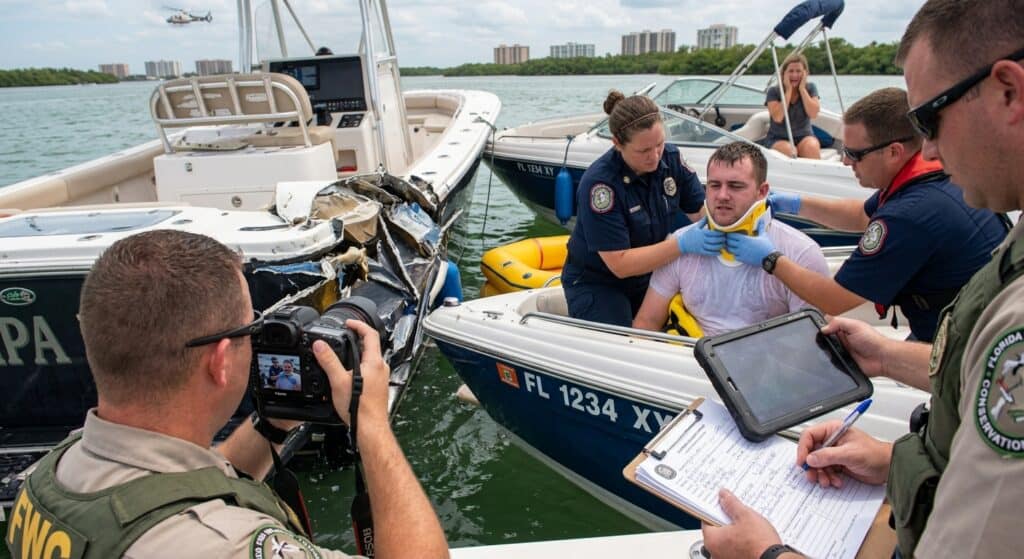
The deadlines differ by severity. A death or disappearance must be reported immediately, by the quickest means available. An accident involving an injury requiring medical treatment must be reported within 48 hours. Property-damage-only accidents meeting the threshold must be reported within 10 days. Reports go to the Florida Fish and Wildlife Conservation Commission (FWC), the sheriff of the county where the accident happened, or the local police chief. Note that a separate federal reporting requirement through the U.S. Coast Guard can also apply, so meeting the state deadline doesn’t automatically satisfy every obligation.
Even when an accident falls under those thresholds, documenting what happened is still worth doing. Law enforcement will sometimes file the report if they investigate at the scene, which is one more reason it’s worth noting who responded and what they told you before you leave.
How This Differs From a Car Accident
A car accident on a Florida road is investigated and reported through the local police department or the Florida Highway Patrol. A boating accident runs through a different agency (the FWC, or the sheriff’s office in some counties) and a different reporting statute entirely, which means the evidence-gathering process, and the deadlines that come with it, work differently too. Insurance coverage is also structured differently on the water: many boat owners are underinsured or carry no liability coverage at all, which changes how a claim actually gets paid.
What This Means for a Claim
Meeting the reporting requirement protects you both ways: it’s a legal obligation for the operator, and it creates an official record an injured passenger, another boater, or a family pursuing a claim can rely on later. If you were hurt in a Florida boating accident, whether as an operator, a passenger, or someone on another vessel, our Port St. Lucie boating accident attorneys can help you sort out what was actually owed under the law, who is responsible, and what coverage may be available.
Who Can Be Held Liable in a Florida Boating Accident
Liability in a boating accident isn’t always limited to whoever was steering. Depending on the facts, responsibility can fall on:
- The vessel operator, for careless or reckless operation, speeding through a no-wake zone, or operating while impaired.
- The boat owner, if they lent the vessel to someone they knew (or should have known) wasn't a safe operator.
- A rental or charter company, if the boat wasn't properly maintained or the renter wasn't given adequate safety instruction.
- A manufacturer, when a defective part, such as a steering system or a kill switch, contributed to the accident.
- Another vessel's operator, in a collision between boats.
More than one of these can apply to the same accident, which is part of why boating accident claims often take longer to sort out than a straightforward car accident.
Common Causes of Florida Boating Accidents
Florida consistently ranks among the states with the most reported boating accidents, and a handful of causes show up repeatedly:
- Operator inattention or distraction,
- Boating under the influence of alcohol or drugs, a separate criminal offense under Florida law,
- Excessive speed, particularly in crowded inlets and no-wake zones,
- An inadequate lookout, especially at dusk or in low visibility,
- Mechanical or equipment failure, and
- Sudden weather changes, which can turn a routine trip dangerous with little warning.
What Evidence Matters Beyond the Official Report
The written accident report is the starting point, not the whole picture. Photos of the vessels and the scene, contact information from any witnesses on the water, and the GPS or electronics data many modern boats log automatically can all end up mattering later, especially if the other operator’s account of what happened differs from yours. Weather conditions at the time, easy to check after the fact through NOAA marine records, can also help establish whether visibility or sea conditions played a role.
Comparative Negligence on the Water
Just as with car accidents, Florida applies comparative negligence principles to boating accident claims. If you contributed to the accident, by standing while the boat was underway, for example, or not wearing an available life jacket in rough conditions, your compensation is reduced by your share of fault, and under the modified rule Florida adopted in March 2023, being found more than 50% at fault bars recovery entirely. That makes the evidence-gathering steps above more important than they might seem: a clear, well-documented account of what actually happened protects you against an insurer’s attempt to shift blame onto you after the fact. It’s also why speaking with an attorney before giving a detailed statement to any insurance company, including your own, is worth doing early rather than after your account has already been recorded.
FAQ
What is the first thing I must do after a boating accident in Florida?
Stop the vessel, render aid to anyone injured, and give your name, address, and vessel identification to anyone injured and to the owner of any damaged property, before anything else.
Do I have to file a written report for every boating accident?
No. A written report is only required for accidents involving death, disappearance, an injury needing treatment beyond immediate first aid, or $2,000 or more in property damage or the complete loss of a vessel.
Who do I report a Florida boating accident to?
Typically the Florida Fish and Wildlife Conservation Commission, though the county sheriff’s office or local police may also take the report depending on where the accident happened.
What if the other boater refuses to exchange information?
Contact law enforcement immediately. Failing to provide that information is itself a violation, separate from whatever caused the accident.
I was a passenger, not the operator. Does any of this affect my claim?
It can. The official accident report is often the first piece of evidence an attorney reviews when building a claim on a passenger’s behalf, so its accuracy matters even though the duty to file it falls on the operator.
What if I was injured on a rented or borrowed boat?
You may have a claim against the renter, the rental company, or both, depending on whether the accident was caused by operator error, poor maintenance, or inadequate safety instruction.
Does Florida require boater education?
Florida requires boater education for anyone born on or after January 1, 1988, who operates a vessel with 10 horsepower or more. Whether the operator met that requirement can become relevant in a liability dispute.
How long do I have to file a boating accident injury claim?
Florida’s general personal injury statute of limitations applies, but boating accidents can raise maritime law questions that shift the timeline, so it’s worth having a claim reviewed sooner rather than later.
Does Florida require boat insurance?
Unlike auto insurance, Florida doesn’t require boat owners to carry liability insurance, which is a major reason so many boating accident victims end up relying on their own coverage rather than the other operator’s.
What if the accident happened in federal waters rather than Florida state waters?
Accidents beyond Florida’s state waters can fall under federal maritime law instead of Florida statutes, which changes both the reporting requirements and the legal standards that apply, so it’s worth having that jurisdictional question answered early.
Recent Posts