
Slip & Fall · Premises Liability
What to Do After a Slip and Fall Accident in Florida
The first hours and days after a slip and fall accident decide what evidence still exists. Here’s what to do, what to avoid, and why Florida’s slip and fall law makes documentation so important.
Written by the Hughes & Barnard Law Firm, P.A. marketing team·Prepared for review by Attorney Howard M. Hughes·Attorney review pending·8 min read

The short answer
After a slip and fall accident, get medical care first. Then report the fall to a manager or the property owner, photograph your shoes and the hazard before anyone cleans it up, collect witness names, and ask in writing that the business preserve its video. Keep the shoes and clothes you were wearing, and don’t give a recorded statement to the property’s insurer before you understand your rights. If you fell on a spill or other substance in a Florida business, the law will generally require you to prove the business knew or should have known about it.
- No general Florida law requires stores to keep surveillance video for a set time, so put your request in writing right away.
- For most falls, you have two years from the date of the fall to file a slip and fall lawsuit.
- If your share of the fault is more than 50%, you generally can’t recover anything.
In this article
- What to do right after a slip and fall accident
- What you’ll have to prove in a Florida store fall
- Evidence that can show the business knew
- What not to do after a slip and fall accident
- How shared fault affects your claim
- If you fell on government property
- How long you have to file after a slip and fall
- Frequently asked questions
What to do right after a slip and fall accident
Falls are the leading cause of nonfatal injuries treated in U.S. emergency departments, with about 8.9 million visits in 2023, according to CDC injury data. If you can do so safely, take these steps to protect your health and the evidence:
- See a doctor, even if you feel okay. Adrenaline can hide fractures, head injuries, and back injuries. Call 911 for any serious injury. Same-day care also creates a medical record that connects your injuries to the fall.
- Report the fall before you leave. Tell a manager or the property owner what happened and ask them to make an incident report. Note who you spoke with and when.
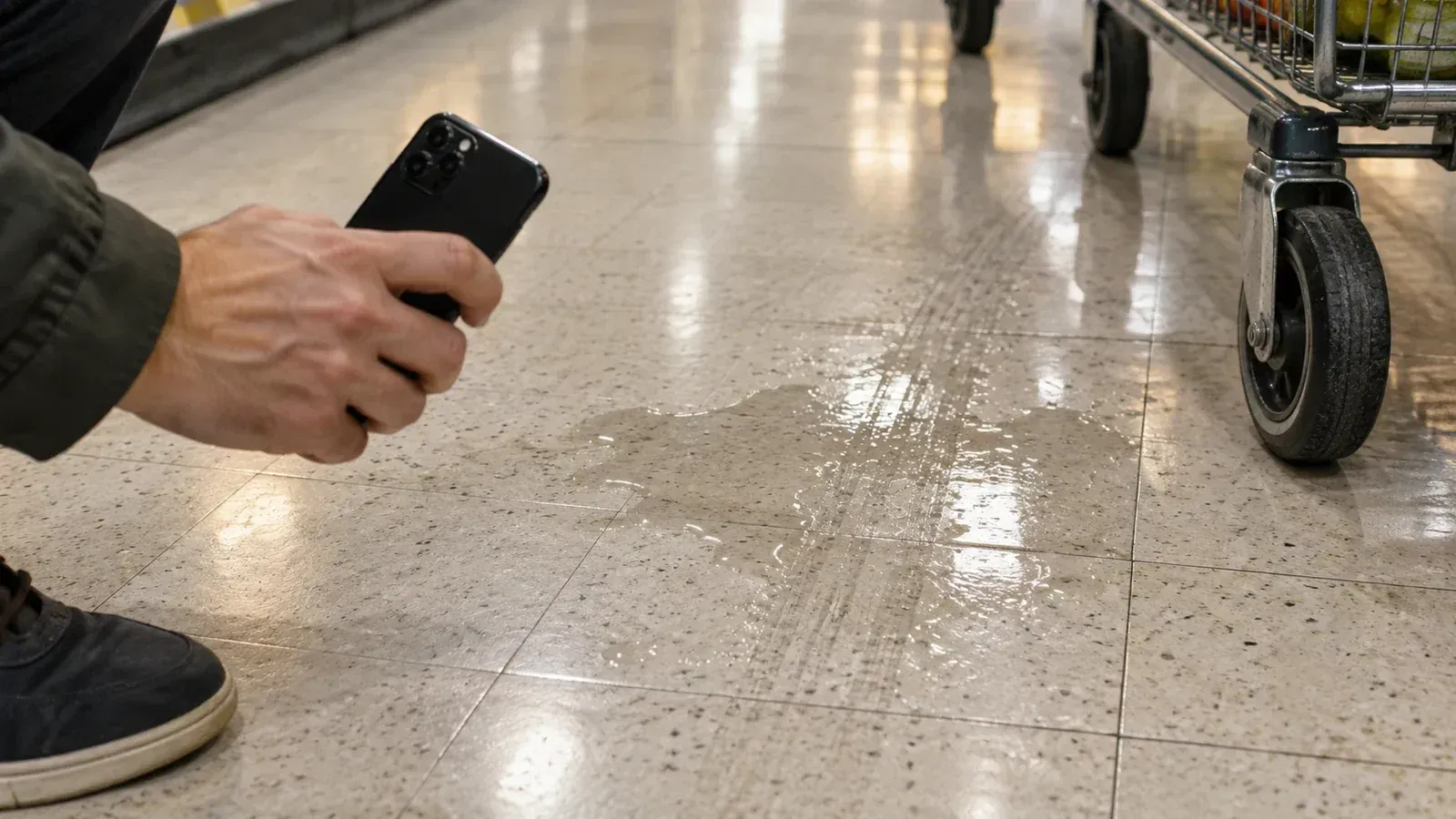
- Photograph the hazard from several angles. Capture the spill or defect, its size, and anything showing how long it had been there, such as footprints or cart tracks through a liquid, dried edges, a leaking cooler, or a curled mat.
- Note warning signs, or the lack of them. Was there a wet-floor sign, and where? Photograph it, or the empty area if there wasn’t one.
- Get witness names and phone numbers. Include customers and employees who saw the fall or the hazard.
- Ask in writing that the business save its video. Many systems record over older footage automatically. A written request matters: it identifies the relevant footage and puts the business on notice of a potential claim. Whether a legal preservation duty exists, and what remedies apply if footage is lost, depends on the facts.
- Keep your shoes and clothing as they are. Don’t wash them or throw them away. They can show what you stepped in and rebut claims about your footwear.
- Write down what you remember while it’s fresh: the time, lighting, what you were doing, and anything employees said.
What you’ll have to prove in a Florida store fall
Florida has a specific statute for falls on a “transitory foreign substance” in a business, meaning something on the floor that doesn’t belong there, like a spilled drink, a dropped grape, or tracked-in rainwater. Under section 768.0755 of the Florida Statutes, you must prove the business had actual or constructive knowledge of the dangerous condition and should have taken action to remedy it.
What the statute says about constructive knowledge
“Constructive knowledge may be proven by circumstantial evidence showing that: (a) The dangerous condition existed for such a length of time that, in the exercise of ordinary care, the business establishment should have known of the condition; or (b) The condition occurred with regularity and was therefore foreseeable.” Section 768.0755(1), Florida Statutes.
That’s why detailed photographs of the hazard matter so much. Footprints and cart tracks through a spill, a substance that has started to dry, or proof the same leak happened before can all help show the business should have found and fixed the problem.
Not every fall involves a “transitory foreign substance.” General premises liability principles govern broken pavement, loose handrails, torn carpet, and poor lighting. Florida property owners generally owe invited customers two duties: to use reasonable care to keep the premises reasonably safe, and to warn of concealed dangers they know or should know about that the customer doesn’t know about and couldn’t discover with reasonable care. Our premises liability lawyers in Port St. Lucie handle both kinds of cases.
Evidence that can show the business knew
| Evidence | What it can show | How to protect it |
|---|---|---|
| Photos of the hazard | How long it was there (tracks, dried edges, debris) | Take them before you leave, from several angles |
| Surveillance video | When the hazard appeared and who walked past it | Request preservation in writing right away |
| Inspection or sweep logs | Whether employees checked the area, and when | Your lawyer can request them in the claim or lawsuit |
| Witness statements | That employees knew, or that the hazard was there a while | Get names and numbers at the scene |
| Prior incidents or complaints | That the condition happened regularly | Your lawyer can investigate |
| Your shoes and clothing | What you stepped in, and that your footwear was reasonable | Keep them unwashed |
Our article on what evidence is needed for a personal injury claim covers medical and financial records too.
Free consultation
Hurt in a fall? Ask us to help preserve the video.
Store video can disappear quickly. Call us today and a Hughes & Barnard attorney will review your fall at no cost and explain what to do next.
No obligation · Se habla español · Home and hospital visits available
What not to do after a slip and fall accident
- Don’t give a recorded statement to the property’s insurer before you’ve had advice. Adjusters often call quickly, and they can use casual comments to shift blame.
- Don’t sign anything at the scene beyond basic contact information, and don’t sign a release later without understanding it.
- Don’t downplay your injuries. “I’m fine” said out of embarrassment can show up in the incident report.
- Don’t post about the fall or your activities on social media while the claim is open.
- Don’t skip follow-up care. Gaps in treatment are a common reason insurers question an injury.
- Don’t wait. Video, witnesses, and the hazard itself won’t stay around.
How shared fault affects your claim
Florida uses modified comparative negligence. Your percentage of fault reduces your damages, and in lawsuits filed after March 24, 2023, you can’t recover anything under section 768.81(6) if your share of fault is more than 50%. A person found exactly 50% at fault can still recover half of their damages.
Businesses often argue a hazard was “open and obvious” or that the customer wasn’t watching where they were going. Florida courts have held that an obvious hazard may relieve a property owner of the duty to warn about it, but generally not of the separate duty to keep the property reasonably safe. In Aaron v. Palatka Mall, L.L.C. (2005), for example, an appeals court reversed a ruling for a mall after a nighttime fall over a parking lot bumper, because whether the owner kept the premises reasonably safe was a question for a jury. Some conditions are so obvious and not inherently dangerous that they can’t support a claim at all. Our guide to comparative negligence in Florida explains how fault percentages work.
How shared fault changes a recovery
No fault: $100,000
Hypothetical damages of $100,000, before fees, costs, liens or coverage limits.
30% at fault: $70,000
The recovery is reduced by the injured person’s share of fault.
51% at fault: $0
In a covered negligence case, more than 50% fault bars recovery.
Hypothetical examples under section 768.81, generally for negligence lawsuits filed after March 24, 2023. Exactly 50% fault allows a reduced recovery. The more-than-50% bar in subsection (6) doesn’t apply to medical negligence.
If you fell on government property
If you fell in a public building, a park, or on other property of a Florida state or local government agency, the claim runs through section 768.28, Florida’s limited waiver of sovereign immunity. You generally must give written notice to the agency, and in many cases to the Florida Department of Financial Services, within three years, and you can’t sue until the agency or the Department denies the claim or six months pass. Section 768.28 caps damages at $200,000 per person and $300,000 per incident unless the Legislature approves more or the agency settles within its insurance coverage. A 2026 bill to raise those caps passed the Legislature, but the Governor vetoed it, so the existing limits still apply.
How long you have to file after a slip and fall
For falls after March 24, 2023, most Florida slip and fall lawsuits have a two-year deadline, measured from the date of the fall, under section 95.11(5)(a). If you fell on or before that date, an older four-year deadline may still apply. Our guide on how long you have to sue after a slip and fall covers the exceptions, and our Port St. Lucie slip and fall attorneys can confirm which deadline applies to you.
Frequently asked questions
Should I see a doctor if I feel fine after a fall?
Yes. Some injuries, including head injuries and fractures, aren’t obvious right away, and prompt treatment creates a record linking your injuries to the fall.
Do I have to report a slip and fall to the store?
There’s no rule that says you must, but you should. Reporting it before you leave creates a record of the date, time, and place. An incident report does not guarantee footage will be retained. Also ask in writing that the business preserve it; whether a legal preservation duty exists depends on the circumstances.
Can I get a copy of the store’s incident report?
Often not. Florida courts generally treat a business’s incident reports as work product prepared in anticipation of litigation, so the business usually doesn’t have to hand one over. If you write or sign a statement, ask for a copy or photograph it before you hand it back.
How long does a store keep its surveillance video?
It depends on the store. Florida has no general law setting a retention period for store video, and many systems record over footage automatically after a set time. That’s why a written request to preserve the video should go out right away.
What if there was a wet floor sign?
A sign doesn’t automatically end a claim, but it can affect the analysis, including whether the business adequately warned about the hazard and how the parties share fault. The placement and visibility of the sign matter.
Who pays my medical bills after a slip and fall?
At first, usually your own health insurance. Some property insurance policies also include medical payments coverage. If the business is legally responsible, its liability insurance may ultimately pay your damages.
How long do I have to file a slip and fall claim in Florida?
Generally two years from the fall for falls after March 24, 2023. The previous four-year deadline may govern older falls, and claims against government entities have extra notice rules.
Hughes and Barnard Law Firm, PA
Meet the Attorneys
Our attorneys draw on backgrounds defending insurers, hospitals and physicians to represent injured people and families.

Managing Partner
Howard M. Hughes
Howard brings experience as an insurance adjuster and insurance-defense attorney to his work representing injured people. A member of The Florida Bar since 1995, he handles personal injury, wrongful death and premises liability matters.
Read full profile
Partner
Cameron Barnard
Cameron began his legal career defending hospitals, doctors and insurance companies. He now represents injured individuals and families in catastrophic injury, wrongful death and other complex cases, including medical malpractice and nursing home abuse.
Read full profileServing Port St. Lucie, Jupiter and surrounding communities.
This article provides general information about Florida law. It is not legal advice, and reading it does not create an attorney-client relationship. Every case depends on its own facts, and laws change, so speak with a lawyer about your situation. Prepared October 21, 2026. Attorney review is pending; confirm the law and deadlines for your situation.